# Please introduce yourself and your book(s)!
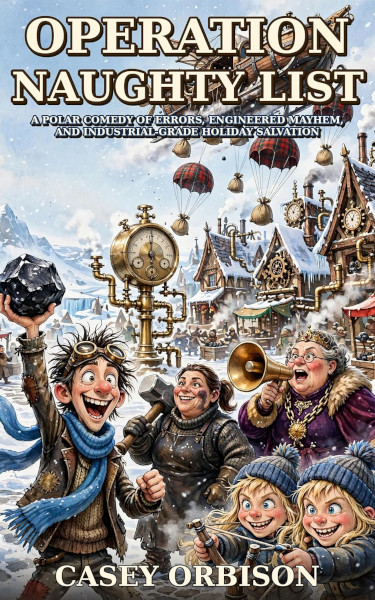
I’m Casey Orbison, an indie author in Idaho Falls, Idaho, where the winters are long and the wind is personal. Operation Naughty List is my first novel — a clockwork Christmas comedy about Permafrost Hollow, a freezing little town whose boiler is dying and whose coal is gone. Then somebody does the math: Santa delivers coal to naughty children. So the whole town sets out to misbehave at industrial scale and earn forty tons of it. It escalates.
# What is/are the real-life story(ies) behind your book(s)?
Honestly? It came to me in a dream — the whole mad arrangement at once: a freezing town, a dying boiler, and the dawning realization that Santa’s lump of coal isn’t a punishment, it’s a delivery. I woke up with Permafrost Hollow fully formed and did the only sensible thing — I followed it. Wrote it down before it could escape. And the detail that kept nagging at me in the cold light of morning was the economics: somebody threatens you with coal every December, but in this economy, isn’t that just free fuel? The town agreed with me. It escalated from there. The other ingredient is Idaho winter itself — when it’s dark by five and the cold genuinely hurts, a town with a dying boiler stops feeling like fiction pretty fast.
# What inspires/inspired your creativity?
Small-town logic, mostly. The way a community can take one absurd idea completely seriously and organize it with clipboards. I spend a lot of time around practical, engineering-minded people, and the comedy of applying rigorous process to total nonsense never gets old to me.
# How do you deal with creative block?
I engineer my way out of it. I outline the mayhem like a project plan, and if a scene won’t move, I write the worst possible version of it on purpose — a bad scene on the page beats a perfect one in my head, because the bad one can be fixed. Half the time the characters ignore the plan anyway and do something funnier.
# What are the biggest mistakes you can make in a book?
Not finishing it is number one — a finished, flawed book can be fixed; a perfect unfinished one is just a rumor. After that: explaining your own jokes, falling so in love with your first draft that you won’t cut anything, and writing what you think the market wants instead of the thing that’s actually funny or true to you.
# Do you have tips on choosing titles and covers?
A title should be a promise and a question at the same time. “Operation Naughty List” is basically the plot and the problem in three words — readers know the tone before they read a single page. For covers: it has to survive the thumbnail. If someone scrolling on a phone can’t read your title and feel your genre in two seconds, the cover is decoration, not a tool.
# How do bad reviews and negative feedback affect you and how do you deal with them?
They sting for about a day, and I’d be lying if I said otherwise. Then I re-read them looking for the one true thing in there — there usually is one, and it’s free editing advice. I never reply publicly; that’s a coal-fired trap. And honestly, around Permafrost Hollow we’ve made our peace with lumps of coal. Coal is fuel.
# How has your creation process improved over time?
I’ve learned to revise in passes with different jobs: one pass for story, one for jokes, one for continuity — because this book required an unreasonable amount of math for a comedy (the town grades its naughtiness on something called the Sinter Scale, measured in pounds of coal). I’ve also learned to let characters ignore my outline productively instead of forcing them back onto it.
# What were the best, worst and most surprising things you encountered during the entire process of completing your book(s)?
Best: the day the town stopped feeling like something I was inventing and started feeling like a place I was reporting from. Worst: the middle-chapter revision slog, where everything is broken in ways only you can see. Most surprising: how emotional I got holding the finished hardcover — and how much spreadsheet work a book about misbehavior requires.
# Do you tend towards personal satisfaction or aim to serve your readers? Do you balance the two and how?
The first draft is for me — I write the joke that makes me laugh at 1 a.m. Every draft after that is for the reader: clearer, tighter, warmer. If it only satisfies me, it’s a diary. If it only chases the reader, it’s homework. The balance is just respecting both jobs.
# What role do emotions play in creativity?
All of it, for comedy especially. You have to genuinely love the town to roast it properly — the jokes in this book work (when they work) because Permafrost Hollow’s people are ridiculous and I adore them anyway. Cold writing makes cold jokes. Readers can tell the difference instantly.
# Do you have any creativity tricks?
Two. First: grade your ideas like the town grades naughtiness — literally rank them, give the best one a ridiculous score, and commit to it; commitment is funnier than cleverness. Second: ask “what is the worst reasonable thing that could happen next?” — not the craziest thing, the worst reasonable one. That’s where the comedy lives.
# What are your plans for future books?
Another Permafrost Hollow story is already causing trouble on my desk. The town has more coal to earn, the constable has more quotas to regret, and Barnaby has not learned a single lesson. I’d like to keep returning to the Hollow every Christmas season if readers will have me.
# Tell us some quirky facts about yourself
I own a coat that could double as a sleeping bag, and in Idaho that’s not a quirk, that’s planning. I have strong, well-researched opinions about porridge as a weapon system. And the Sinter Scale started as a joke in the book and is now genuinely how I plan chapters — I grade my own misbehavior on a spreadsheet, which tells you everything about me.
Links
Book on Amazon: https://www.amazon.com/dp/B0HNYFFWWL
Author page: https://www.amazon.com/stores/Casey-Orbison/author/B0HNZ833JP